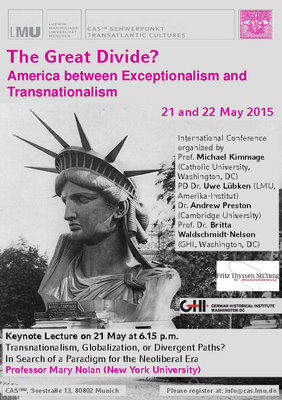
Internationale Konferenz an der LMU München, ausgerichtet von: Michael Kimmage (Catholic University of America), Uwe Lübken (LMU), Andrew Preston, (University of Cambridge), Britta Waldschmidt-Nelson (GHI).
The expression "great divide" presumes a divergence in historical experience, which became pronounced in the 1970s and has intensified ever since. The trend toward democratization, symbolically associated with the year 1989, was emphatically rejected by China. Since 1989, China and Russia have elaborated forms of authoritarian capitalism unique to these powerful nation states. For the past several decades, the E.U. has expanded in pursuit of integration. The recent financial crisis, however, has revealed a plurality of economic models within the E.U. as well as the awkwardness of German or Franco-German leadership in Europe. The E.U. is diversifying along a North-South axis. Outside of Europe, the Iranian Revolution of 1979 was a decisive and consequential break from the West, and from Turkey to Egypt to Pakistan political Islam has emerged as one of the key forces of twenty-first century history. The U.S. has robustly contributed to the great divergence. Its political parties and electoral system, its legal and academic culture, its blend of religiosity and secularism remain stubbornly idiosyncratic by any standard of global comparison. Americanization, a felt reality in postwar Europe and the alleged leitmotif of the globalizing 1990s, has shown itself to be a phenomenon of receding importance. The international scene today betrays little real convergence and much real divergence.
This conference will examine those new departures in historical inquiry that radiate out from the old problem of American exceptionalism.


